
#weirdpoemwednesday
an experiment

A few years ago I started posting poems on social media with the hashtag #smallpoemsunday, and an invitation to anyone who might be interested to share small poems they wrote (or ones they loved by other poets) once a week. I’d been sharing poems on social media for a long while before using this hashtag, but I’d begun to notice that social media seemed to privilege the smaller poem — which fits neatly in a screenshot, can be consumed at a glance — over other forms of poetry. Although I’ve really enjoyed the participatory character of #smallpoemsunday (& still do!), and the bounty of small poems it has surfaced that I might not otherwise have read, I felt there was a need for a bit of a countercurrent: something that pushed against the quickness and slickness of the small poem, subsumed into the stream.
In December of last year I tried another hashtag: #twopageplustuesday — admittedly cumbersome (and, let’s be real, less popular than #smallpoemsunday), I wanted to use this hashtag partially as an accountability measure for myself, to try to make time each week to spend with longer poems — ones that couldn’t necessarily be reduced to a single screenshot, that instead would settle into some duration across 2+ printed pages or multiple images in a carousel. I’ve really enjoyed spending some time with longer poems each week (most recently this showstopper by Ariana Reines), and I still hope to continue this weekly practice along with #smallpoemsunday. But even with both “lengths” of poem in play, something has still felt like it’s been missing.
Initially I thought the logic of social media pretty unilaterally privileged the short poem, but I think it also gives greater weight to another kind of poem, one that could be described or triangulated roughly using a constellation of words like: straightforward, direct, plainspoken, linear (in logic, narrative, image, or storytelling), clear, explicit, comprehensible, coherent, intelligible, etc. etc.
— in other words, I think social media is not always kind to poems that are too weird.
This is not meant to be a black-or-white statement: there are many poems, short and long, that are delightfully strange and that people share widely. (You might have one in mind right now.) But I’ve also noticed, in posting work by more experimental poets (even when they work in short, accessible forms, like Joseph Ceravolo or Russell Atkins), that sometimes the circulation of this kind of work is much narrower, and sometimes even presents active resistance on the part of the reader: is this even poetry?
To be clear, I don’t come to this experiment thinking that circulation is an unqualified good in itself for poems. I don’t necessarily believe the ideal fate of the experimental poet is to be read as widely as possible. But I am interested in the possibilities of participatory poetics to make some more elbow room for the kind of baffling, weird work I’ve written about on this Substack before and that has made me grow as a poet.
So here goes: for the first #weirdpoemwednesday I would like to share a poem by one of my favorite living poets, Philip Jenks:
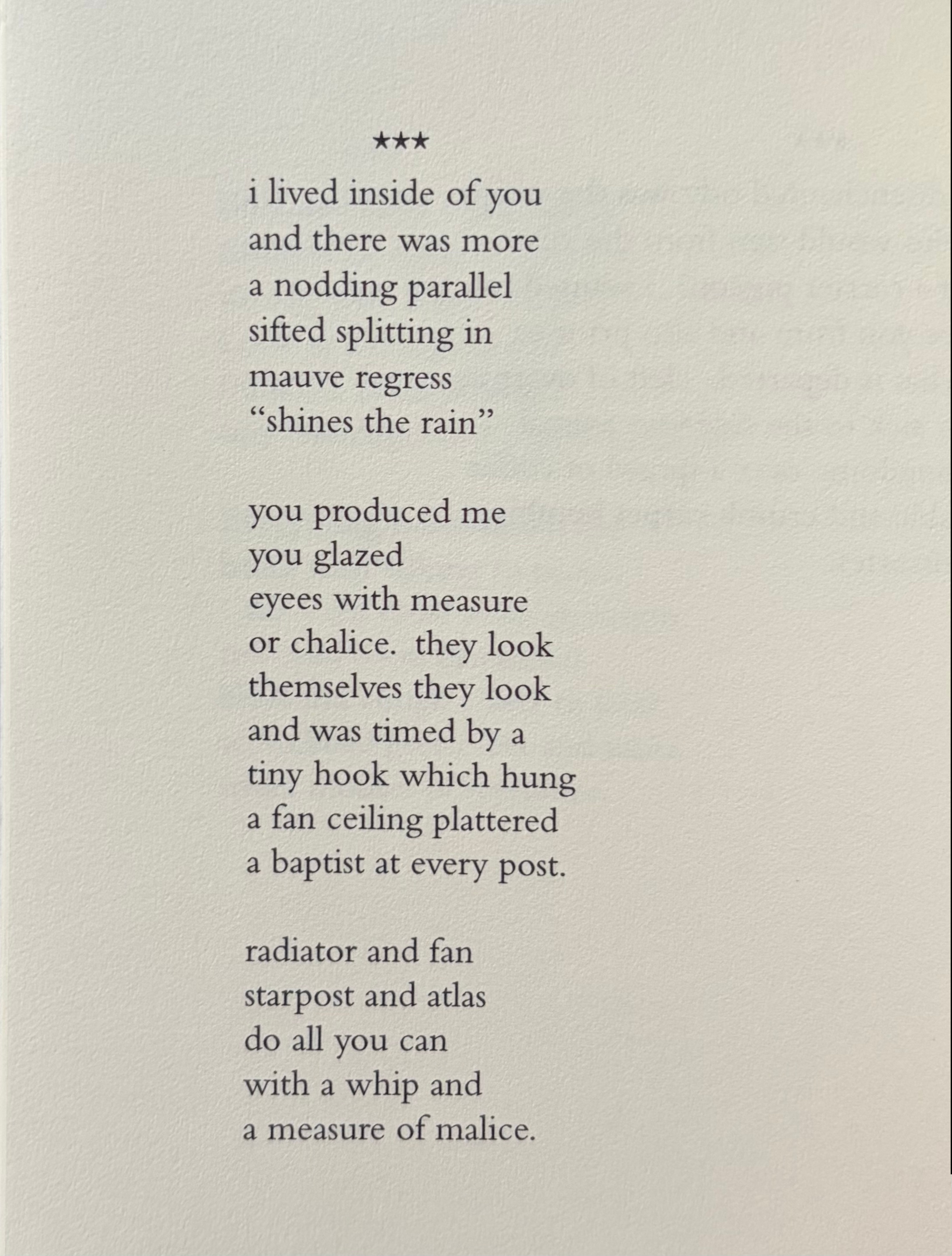
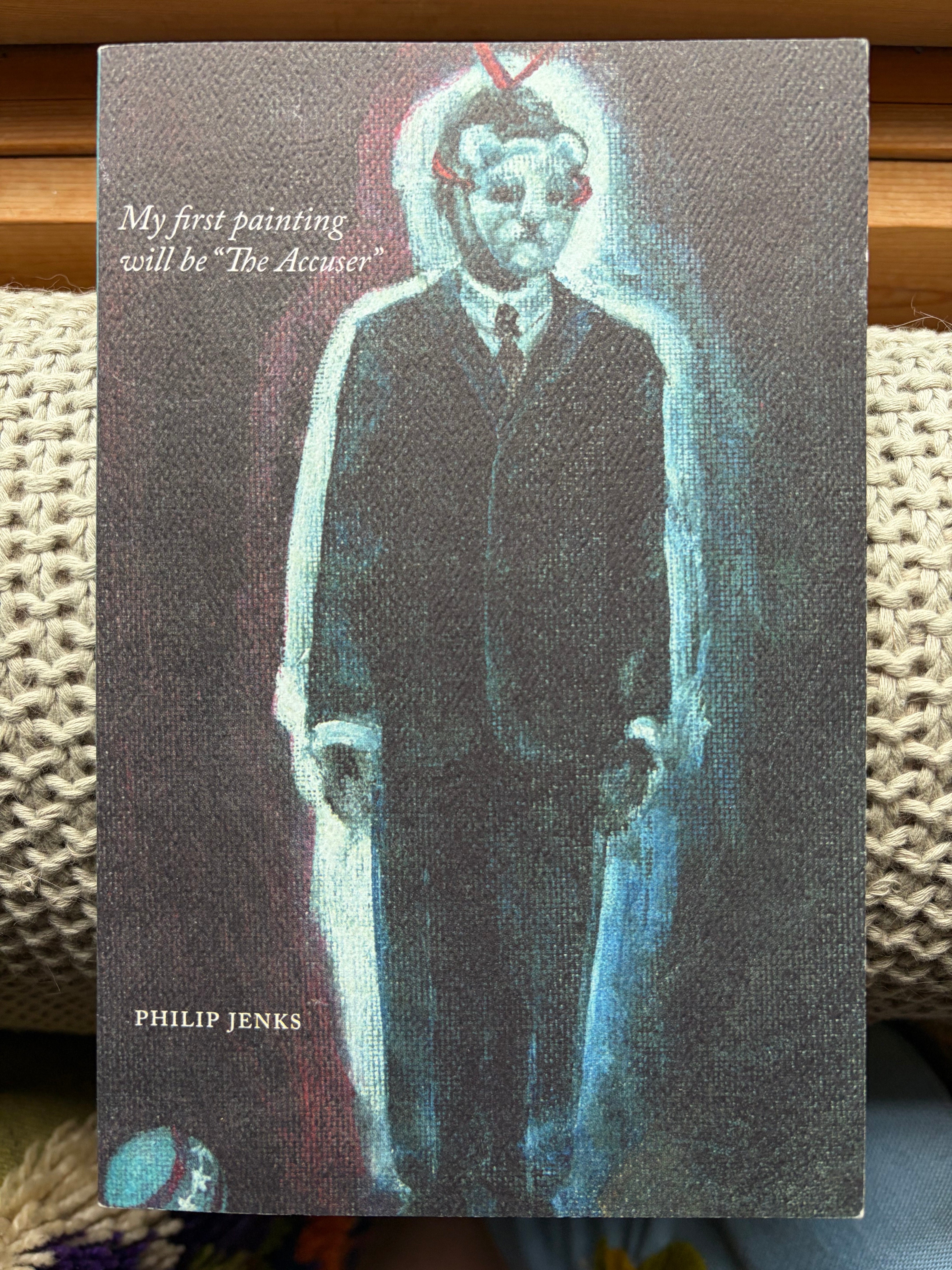
This poem is included in Jenks’s collection My First Painting Will Be “The Accuser” from Zephyr Press. Jenks is the author of several poems I would consider among the best I’ve read, including this one from his Flood Editions book On The Cave You Live In, and the thing I am really drawn to in his work is the way he uses more experimental or surprising gestures within a broader framework of the lyric to tremendous effect.
In general, I’m hoping to let future #weirdpoemwednesday shares stand on their own unique 2+ feet, but I can’t resist saying a few things about this poem and why I like it so much. I love the way it opens with a pair of lines that flirt with the generic or cliché — “i lived inside of you / and there was more” — before torquing their ordinariness with some sonically and visually interesting phrase-sized lines: “a nodded parallel / sifted splitting in / mauve regress”. The double letters in each of these lines are a great recapitulation of the poem’s opening “i” and “you,” the way the “i lived inside of you” is echoed by these double letters cohabitating in shared words. The wobbliness of sense and reference, orthography and semantics, deepens with the conspicuously in-quotes “shines the rain” — this isn’t, to me, a recognizable quotation from a source I know, but there is an old hymn by Ruth Benson Lehenbauer that includes these words:
My Heav’nly Father gives me all good and lovely things:
The sun that shines, the rain that falls, the meadowlark that sings.

I’m glad to pay a tithing, one-tenth of all I earn;
It’s little when I think of all God gives me in return.
Emphasis mine. So if this is a quote from the hymn, it’s a bit off-kilter in that it gets the logic of the list wrong: it combines “shines” (describing “The sun”) with “the rain”, kind of like the blurring of the “i” and “you” we started with and that gets an extra dimension in the second stanza, which opens: “you produced me”. Then comes one of my favorite moments in the poem, the word “eyees” with a double “e”. I think this is a deliberate move that plays with redoubling like Aram Saroyan’s (in)famous “lighght,” tricking your brain for a quick moment: before you even subvocalize the word your brain is already stretching the “eye,” which of course rhymes with “i,” past where it would normally go if the typo weren’t present. The result is a fascinatingly prehensile effect, which also anticipates the double “look” in the following lines and the unique pairs of compounds that open the last stanza (“radiator and fan” / “starpost and atlas” — such great “a” sounds there!). I’ll leave the music and mystery of the last three lines to you to think about, and I also warmly invite you to share your favorite weird poem for #weirdpoemwednesday — if you do, please feel free to tag me here, here, or here :)
This gives me hope that I may be able to compose something that qualifies as a 'weird poem'
🤩😍😘